Love this? Save it for later!
Share the inspiration with your friends
My sister swore she hated bread. The whole category. For years.
She’d push dinner rolls to the side of her plate, turn down sandwiches on crusty loaves, and give my homemade baguettes a polite but firm “no, thank you.” It was almost a family joke at this point. “Bread is just a vehicle for butter,” she’d say, “and I don’t need the vehicle.” I mean, okay. We all have our quirks, right?
Then I made this Wholesome Sourdough Focaccia with Rosemary and Flaky Salt on a quiet Tuesday afternoon, mostly because I had a neglected sourdough starter in the fridge that was giving me the side-eye. I wasn’t trying to prove anything. I just wanted focaccia. The dough came together in a sticky, shaggy mess on my counter, and I let it rise while I cleaned out a drawer I’d been avoiding for months. That’s the kind of cooking I do—half-focused, always multitasking, usually with flour on my jeans.
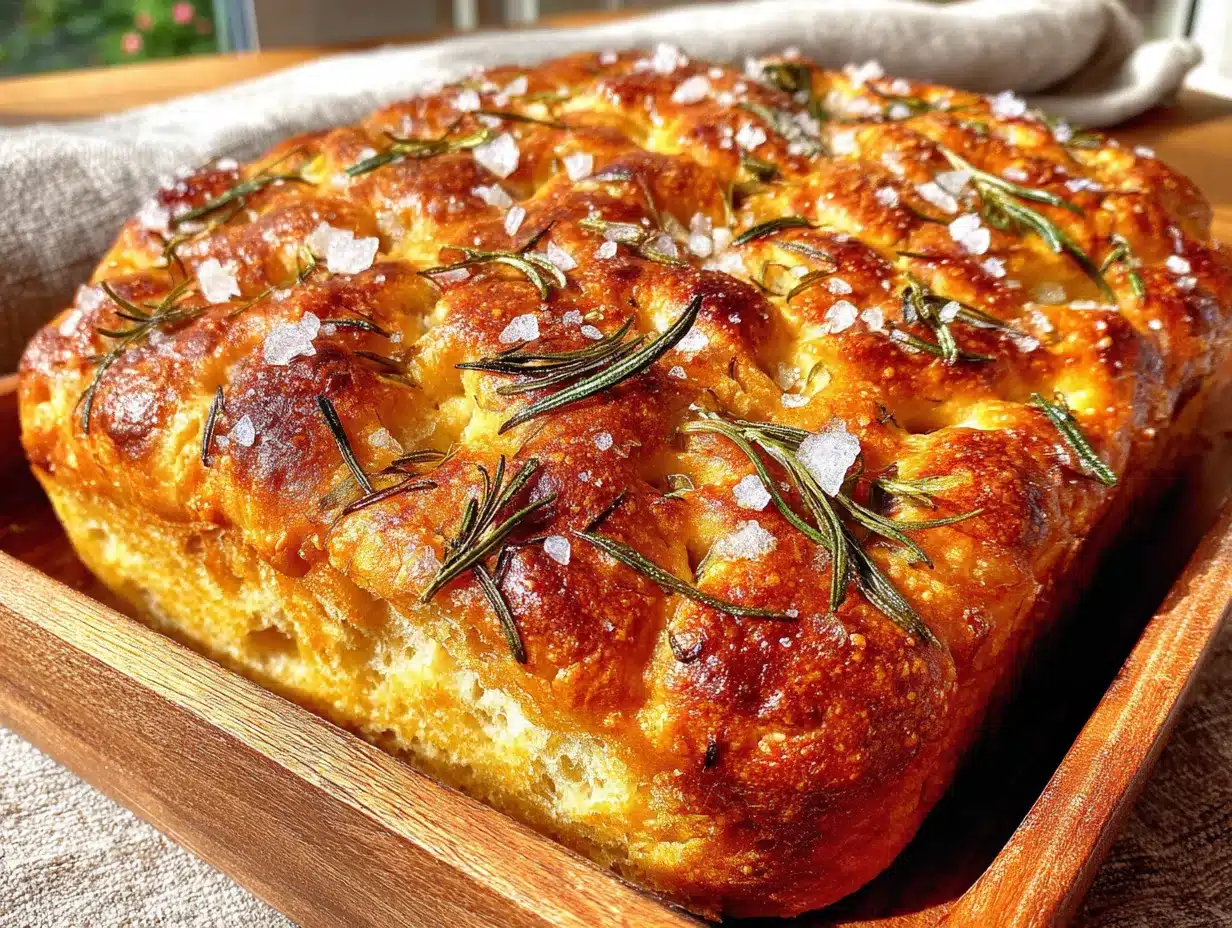
I pulled the pan out of the oven, the top perfectly blistered and golden, the rosemary crackling from the heat. I set it on the counter to cool and walked away to answer a text. When I came back, my sister was standing there, elbow-deep in the middle of the focaccia, tearing off a piece with this look on her face. Caught. Red-handed. Or, well, olive-oil-handed.
“This doesn’t count,” she said, mouth half-full. “This is different.”
And honestly? She was right. This sourdough focaccia is different. It’s got that tangy depth from the slow-fermented starter, a texture that’s crispy on the outside and impossibly airy on the inside, and just enough olive oil to make it feel indulgent without being heavy. The rosemary and flaky salt aren’t just toppings—they’re the finishing touch that makes you understand why people have been obsessed with this bread for centuries.
Maybe you’ve got someone in your life who claims to not like bread. Or maybe you’re the one who’s been skeptical about working with sourdough, thinking it’s too fussy for a Tuesday afternoon. I get it. But this recipe? It might just change your mind. It changed hers. And I keep making it because it proves something I’ve always suspected: sometimes the best things happen when you’re not trying to convince anyone.
Why You’ll Love This Wholesome Sourdough Focaccia
Let me tell you why this particular focaccia has earned a permanent spot in my weekly rotation. I’ve tested this recipe more times than I can count, tweaking hydration levels and proofing times until it felt just right. It’s not just another bread recipe—it’s the one I reach for when I want something that feels both special and totally doable.
- Simple Ingredients : You only need flour, water, sourdough starter, olive oil, salt, rosemary, and more salt. That’s it. No yeast packets, no fancy additives. Your pantry probably has everything except maybe the fresh rosemary.
- Minimal Hands-On Time : Yes, there’s a long fermentation, but the actual work is maybe 15 minutes spread across the day. The dough does the heavy lifting while you live your life.
- Perfect for Beginners and Sourdough Pros : Focaccia is the most forgiving bread I know. If your starter isn’t super active or your shaping is messy, it still turns out beautiful. It’s practically impossible to mess up.
- Healthier Than Store-Bought : The long fermentation breaks down gluten and phytic acid, making it easier to digest. Plus, you control the quality of every ingredient. No preservatives, no weird additives.
- Incredibly Satisfying : There’s something about pulling a golden, fragrant pan of focaccia out of the oven that makes you feel like you’ve accomplished something real. And the first bite? Pure comfort.
What makes this version different from the dozens of focaccia recipes out there is the sourdough starter. It adds a subtle tang that balances the richness of the olive oil and the piney freshness of the rosemary. It’s not overpowering—just enough to make you wonder why you haven’t been making focaccia this way all along. Honestly, once you try it, you’ll understand why my sister couldn’t resist.
What Ingredients You Will Need
This Wholesome Sourdough Focaccia uses a short list of simple ingredients, but each one plays an important role. Here’s what you’ll need and why they matter.
For the Dough
- 4 cups (500g) bread flour – I prefer King Arthur or Bob’s Red Mill for consistent protein content. Bread flour gives the focaccia that chewy, airy structure. All-purpose works in a pinch, but the texture won’t be quite as springy.
- 1 ½ cups (360ml) lukewarm water – Not hot, not cold. Think bathwater temperature. This helps the fermentation process without killing the beneficial bacteria in your starter.
- 1 cup (240g) active sourdough starter – Use it when it’s bubbly and doubled in size, ideally fed 4-6 hours before. A hungry starter won’t give you the same rise or flavor.
- ¼ cup (60ml) extra-virgin olive oil – Don’t skimp here. Good olive oil is the backbone of this recipe. I use California Olive Ranch for a fruity, peppery flavor that shines through.
- 2 teaspoons (10g) fine sea salt – Regular table salt works, but sea salt dissolves more evenly into the dough.
For the Topping
- 2-3 tablespoons fresh rosemary, finely chopped – Fresh is non-negotiable here. Dried rosemary won’t soften properly during baking and can be a bit sharp. I grow my own, but grocery store bunches work great.
- 1-2 teaspoons flaky sea salt – Maldon is my go-to. Those big, delicate flakes create little bursts of saltiness that make every bite interesting.
- 2-3 tablespoons extra-virgin olive oil – For drizzling on top before and after baking. It adds richness and helps the salt and rosemary stick.
Ingredient Tips: If you don’t have bread flour, you can substitute all-purpose flour, but reduce the water by about 2 tablespoons to account for the lower absorption. For a whole wheat version, swap 1 cup of the bread flour for whole wheat flour—it’ll be a bit denser but still delicious. And if you’re out of fresh rosemary, try fresh thyme or oregano instead. They bring a different but equally lovely flavor.
Equipment Needed
You don’t need a lot of fancy tools to make this Wholesome Sourdough Focaccia, which is part of its charm. Here’s what I use:
- 9×13-inch baking pan – A metal or glass pan works. Metal gives a slightly crispier bottom. I’ve used both and honestly prefer metal for that extra crunch.
- Large mixing bowl – Any bowl big enough to hold the dough as it rises. Glass or ceramic is great because you can see the bubbles forming.
- Bench scraper or spatula – Helps with folding the dough and getting it out of the bowl. A flexible silicone spatula works too.
- Kitchen scale – Not required, but I highly recommend it. Measuring flour by weight is way more accurate than scooping, especially with sourdough where hydration matters.
- Plastic wrap or a damp kitchen towel – To cover the dough while it rises. A shower cap actually works perfectly in a pinch.
- Parchment paper – Optional, but it makes cleanup a breeze. I use it every time now.
If you don’t have a 9×13 pan, a 10-inch cast iron skillet or a round cake pan works too. The shape will be different, but the focaccia will still be amazing. I’ve even used a disposable aluminum pan when traveling—worked like a charm.
Preparation Method
Making this Wholesome Sourdough Focaccia is a process that spans most of a day, but don’t let that intimidate you. Most of the time is passive—you’re just waiting for the dough to do its thing. Here’s the step-by-step.
- Feed your starter (morning, 8-9 AM) – If your starter has been sitting in the fridge, take it out and feed it with equal parts flour and water. Let it sit at room temperature until it’s bubbly and active, about 4-6 hours. You need 1 cup of active starter for this recipe.
- Mix the dough (around 1 PM) – In a large bowl, combine the bread flour and fine sea salt. Add the lukewarm water and active sourdough starter. Use your hands or a spatula to mix until there are no dry bits of flour left. The dough will look shaggy and rough—that’s perfect. Cover the bowl with plastic wrap and let it rest for 30 minutes. This is called autolyse, and it helps the flour absorb the water and develop gluten naturally.
- First stretch and fold (1:30 PM) – Wet your hands to prevent sticking. Grab one side of the dough, stretch it up, and fold it over the top. Rotate the bowl 90 degrees and repeat. Do this 4 times total (all four sides). Cover and rest 30 minutes.
- Second stretch and fold (2:00 PM) – Repeat the same process. The dough should feel a bit smoother and more elastic already. Cover and rest another 30 minutes.
- Third stretch and fold (2:30 PM) – Do one more round of stretch and folds. By now, the dough should be pulling away from the bowl and feeling supple. Cover and let it rest for the bulk fermentation, which takes about 4-6 hours at room temperature (70-75°F). The dough should double in size and look bubbly on the surface.
- Prepare the pan (around 6-7 PM) – Pour 2 tablespoons of olive oil into your 9×13 pan and spread it around. Gently turn the dough out into the pan. Don’t punch it down—you want to keep those air bubbles. Let the dough rest for 30 minutes.
- Dimple the dough (6:30-7:30 PM) – Drizzle another tablespoon of olive oil over the top. Use your fingertips to press dimples all across the surface of the dough. Push all the way to the bottom of the pan. This isn’t just for looks—the dimples hold the oil and create those signature focaccia pockets. Cover and let it rise for another 2-3 hours, until the dough is puffy and jiggly.
- Preheat and top (around 9-10 PM) – Preheat your oven to 425°F (220°C). Sprinkle the chopped rosemary and flaky sea salt evenly over the dimpled dough. Drizzle one more tablespoon of olive oil on top.
- Bake – Place the pan on the middle rack and bake for 25-30 minutes, until the top is deep golden brown and the edges are crispy. The internal temperature should reach about 200°F (93°C). Let it cool in the pan for 10 minutes, then transfer to a wire rack.
- Cool and serve – Let the focaccia cool for at least 20 minutes before slicing. I know it’s tempting to tear into it right away, but it continues to set as it cools. Plus, you won’t burn your mouth.
Sensory cues: When you dimple the dough, it should feel soft and airy, like a memory foam pillow. The dough should spring back slowly when poked. If it feels tight or resistant, let it rest another 30 minutes before dimpling. During baking, your kitchen will smell like a fancy Italian bakery—that’s how you know it’s working.
Cooking Tips & Techniques
After making this Wholesome Sourdough Focaccia at least two dozen times, I’ve collected a few hard-won lessons. Here are the things I wish I’d known from the start.
Don’t rush the fermentation. The first time I made this, I was impatient and baked it after only 3 hours of bulk fermentation. The flavor was flat and the texture was dense. Sourdough needs time to develop that signature tang and airy crumb. If your kitchen is cold, find a warm spot—on top of the fridge or near a sunny window works great. A cold kitchen can double the fermentation time, so plan accordingly.
Use enough oil. Focaccia is an oil-based bread, and skimping on the olive oil leads to a dry, sad result. I once tried to cut the oil in half for a “lighter” version, and it was a disaster. The crust didn’t crisp up, and the bread stuck to the pan. Embrace the olive oil. Your taste buds will thank you.
Wet your hands. Sourdough focaccia dough is sticky—like, really sticky. If you try to handle it with dry hands, you’ll end up with a mess on your fingers and frustration in your heart. Keep a small bowl of water nearby and dip your hands before each stretch and fold. It makes the process so much smoother.
Let it cool properly. I know the smell is intoxicating, but cutting into hot focaccia will give you a gummy interior. The starches need time to set. I usually let it cool on a wire rack for at least 30 minutes, but honestly, it’s even better after an hour. The texture becomes perfectly chewy and light.
Variations & Adaptations
One of the best things about this Wholesome Sourdough Focaccia is how flexible it is. Here are some ways to make it your own.
Herb and Garlic Focaccia – Skip the rosemary and add 2 cloves of minced garlic and a tablespoon of mixed dried herbs (thyme, oregano, basil) to the olive oil before dimpling. The garlic infuses the oil and creates a savory, aromatic bread that’s amazing with pasta dishes.
Everything Bagel Focaccia – After dimpling, sprinkle the top with everything bagel seasoning (sesame seeds, poppy seeds, dried garlic, dried onion, and salt). Bake as directed. This version is dangerously addictive and perfect for breakfast with cream cheese.
Olive and Sun-Dried Tomato Focaccia – Press ½ cup of pitted Kalamata olives and ¼ cup of chopped sun-dried tomatoes into the dough after dimpling. The salty, tangy bursts of flavor take this bread to another level. I made this for a potluck once, and it disappeared in 10 minutes.
Whole Wheat Variation – Substitute 1½ cups of the bread flour with whole wheat flour. The texture will be a bit denser and nuttier, but it’s still incredibly satisfying. Add an extra tablespoon of water since whole wheat absorbs more liquid.
Gluten-Free Option – I haven’t personally tested this with gluten-free flour, but I’ve heard good things about using a 1:1 gluten-free baking blend. The hydration will need adjusting, so start with slightly less water and add more as needed. Let me know if you try it!
Serving & Storage Suggestions
This Wholesome Sourdough Focaccia is best served warm, but it’s honestly delicious at any temperature. Here’s how I like to enjoy it.
Serving Ideas: Tear it into rough pieces and serve alongside a bowl of tomato soup or a hearty minestrone. Use it for sandwiches—it makes the best turkey and pesto sandwich you’ll ever have. Or just eat it plain, dipped in a mixture of balsamic vinegar and olive oil. It’s also incredible toasted the next day with a fried egg on top for breakfast.
Storage: Keep leftover focaccia in an airtight container at room temperature for up to 3 days. Don’t refrigerate it—the fridge dries out bread faster than anything. If you won’t finish it in 3 days, slice it and freeze it in a zip-top bag for up to 3 months.
Reheating: The best way to revive focaccia is to pop it in a 350°F oven for 5-7 minutes. It’ll crisp right back up. A toaster oven works great too. Avoid the microwave unless you want sad, rubbery bread.
Flavor Development: Honestly, this focaccia is even better on day two. The flavors meld together and the tang from the sourdough becomes more pronounced. If you can resist eating it all on day one, you’re in for a treat.
Nutritional Information & Benefits
While I wouldn’t call focaccia a health food, this Wholesome Sourdough Focaccia is definitely a better choice than store-bought breads. Here’s a rough estimate per serving (1/8 of the pan):
- Calories: ~280
- Carbohydrates: 38g
- Protein: 7g
- Fat: 11g
- Fiber: 2g
Health Benefits: The long fermentation process breaks down phytic acid, which makes the minerals in the flour more bioavailable. It also partially digests the gluten, which can make it easier on your digestive system. The olive oil provides healthy monounsaturated fats and antioxidants. And rosemary is packed with anti-inflammatory compounds.
Dietary Considerations: This recipe is vegetarian and vegan (no dairy or eggs). It’s not gluten-free, but the fermentation does make it more digestible for some people with mild gluten sensitivities. It contains wheat, so it’s not suitable for celiac disease.
I love that this bread lets me enjoy something indulgent without feeling guilty. It’s made with real, whole ingredients, and I know exactly what went into it. That matters to me.
Conclusion
This Wholesome Sourdough Focaccia with Rosemary and Flaky Salt has become a staple in my kitchen for good reason. It’s forgiving enough for a beginner, rewarding enough for an experienced baker, and delicious enough to convert even the most stubborn bread skeptics (yes, I’m still talking about my sister).
The magic of this recipe is in the process—the slow fermentation, the stretch and folds, the moment you pull that golden pan out of the oven and watch the rosemary crackle. It’s not just bread; it’s a little piece of handmade goodness that makes any meal feel special.
I’d love to hear how yours turns out. Did you try a variation? Did someone in your house get caught sneaking a piece before it cooled? Drop a comment below and let me know. And if you loved this recipe, share it with a friend who needs a little more homemade bread in their life.
Happy baking, friend. Your kitchen is about to smell amazing.
Frequently Asked Questions
Can I use active dry yeast instead of sourdough starter?
This recipe is specifically designed for sourdough starter, so I don’t recommend substituting yeast directly. The long fermentation and tangy flavor come from the wild yeast and bacteria in the starter. If you don’t have a starter, try a traditional focaccia recipe with yeast first, then come back to this one once you’ve got your starter going.
My dough is too sticky. What did I do wrong?
Sticky dough is actually normal for high-hydration focaccia! Don’t add extra flour—that will make it dense. Instead, wet your hands with water before handling the dough. The stickiness means you have good hydration, which leads to those beautiful air pockets. Trust the process.
Can I refrigerate the dough overnight?
Absolutely! After the bulk fermentation (step 5), you can cover the bowl and refrigerate the dough for up to 24 hours. The next day, let it come to room temperature for about an hour before transferring it to the oiled pan. This actually develops even more flavor. I do this often when I want focaccia for lunch.
Why didn’t my focaccia rise much?
There are a few common culprits: your starter wasn’t active enough (it should be bubbly and doubled), your kitchen was too cold, or you used too much salt which can slow down fermentation. Make sure your starter is vigorous before using it, and find a warm spot for the dough to rise. A little patience goes a long way.
How do I get more bubbles in my focaccia?
Higher hydration (more water) creates more bubbles, but it also makes the dough harder to handle. The key is gentle handling—don’t punch the dough down when transferring it to the pan. Also, make sure your starter is really active. I’ve found that using a slightly wetter dough (add an extra tablespoon of water) and being very gentle during the dimpling stage gives me the best, most dramatic bubbles.
Pin This Recipe!
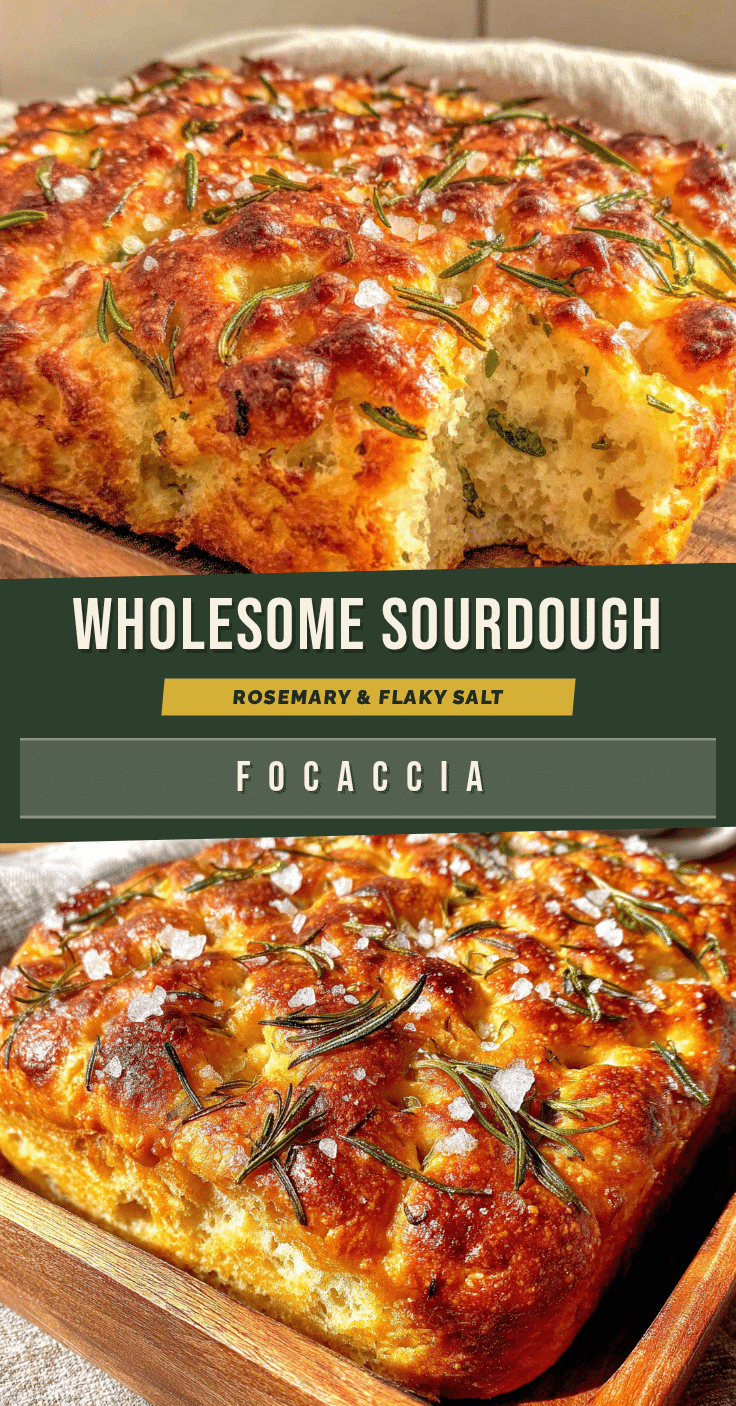
Wholesome Sourdough Focaccia with Rosemary and Flaky Salt

This tangy, airy sourdough focaccia is crispy on the outside and impossibly light on the inside, topped with fragrant rosemary and flaky sea salt. It’s forgiving enough for beginners and rewarding enough for experienced bakers, making it the perfect bread to convert even the most stubborn bread skeptics.
- Prep Time: 15 minutes
- Cook Time: 25-30 minutes
- Total Time: 8-10 hours (including fermentation)
- Yield: 8 servings 1x
- Category: Bread
- Cuisine: Italian
Ingredients
- 4 cups (500g) bread flour
- 1 ½ cups (360ml) lukewarm water
- 1 cup (240g) active sourdough starter
- ¼ cup (60ml) extra-virgin olive oil
- 2 teaspoons (10g) fine sea salt
- 2–3 tablespoons fresh rosemary, finely chopped
- 1–2 teaspoons flaky sea salt
- 2–3 tablespoons extra-virgin olive oil (for topping)
Instructions
- Feed your starter (morning, 8-9 AM): If your starter has been sitting in the fridge, take it out and feed it with equal parts flour and water. Let it sit at room temperature until bubbly and active, about 4-6 hours. You need 1 cup of active starter.
- Mix the dough (around 1 PM): In a large bowl, combine the bread flour and fine sea salt. Add the lukewarm water and active sourdough starter. Mix until no dry bits remain. The dough will look shaggy. Cover and let rest for 30 minutes (autolyse).
- First stretch and fold (1:30 PM): Wet your hands. Grab one side of the dough, stretch it up, and fold it over the top. Rotate the bowl 90 degrees and repeat 4 times total. Cover and rest 30 minutes.
- Second stretch and fold (2:00 PM): Repeat the same process. Cover and rest 30 minutes.
- Third stretch and fold (2:30 PM): Do one more round of stretch and folds. Cover and let bulk ferment for 4-6 hours at room temperature (70-75°F) until doubled in size and bubbly.
- Prepare the pan (around 6-7 PM): Pour 2 tablespoons of olive oil into a 9×13-inch pan and spread it around. Gently turn the dough out into the pan. Don’t punch it down. Let rest for 30 minutes.
- Dimple the dough (6:30-7:30 PM): Drizzle another tablespoon of olive oil over the top. Use your fingertips to press dimples all across the surface, pushing to the bottom of the pan. Cover and let rise for another 2-3 hours until puffy and jiggly.
- Preheat and top (around 9-10 PM): Preheat oven to 425°F (220°C). Sprinkle chopped rosemary and flaky sea salt evenly over the dough. Drizzle one more tablespoon of olive oil on top.
- Bake: Place pan on the middle rack and bake for 25-30 minutes until deep golden brown and edges are crispy. Internal temperature should reach about 200°F (93°C). Cool in pan for 10 minutes, then transfer to a wire rack.
- Cool and serve: Let cool for at least 20 minutes before slicing. The texture continues to set as it cools.
Notes
Don’t rush the fermentation; a cold kitchen can double the time. Use enough olive oil for a crispy crust. Wet your hands to handle sticky dough. Let cool properly to avoid a gummy interior. The focaccia is even better on day two.
Nutrition
- Serving Size: 1/8 of the pan
- Calories: 280
- Sodium: 480
- Fat: 11
- Saturated Fat: 1.5
- Carbohydrates: 38
- Fiber: 2
- Protein: 7
Keywords: sourdough focaccia, rosemary focaccia, homemade bread, sourdough bread, focaccia recipe, easy sourdough, artisan bread