Love this? Save it for later!
Share the inspiration with your friends
I swore I wasn’t a soup person. For years. I’d look at recipes for creamy this and brothy that and think, “That’s not a meal, that’s a warm beverage with stuff floating in it.” Winter after winter, my family would ladle themselves bowls of steaming soup while I sat there with a sandwich, utterly convinced I was missing nothing. Then last October, my neighbor Margaret showed up at my door holding a slow cooker, looking slightly guilty. She’d made too much soup for her book club and wondered if I’d take it off her hands. I took it to be polite, set it on the counter, and forgot about it until dinner time.
The smell hit me first. Not just apple or squash but something deeper, almost caramelized. I warmed a bowl more out of obligation than curiosity, and honestly, I was ready to be proven right. That first spoonful was embarrassingly good. The texture was velvety without being heavy, and the sweetness of the apples balanced the earthiness of the squash in a way I hadn’t expected. I ate two bowls. Then I texted Margaret for the recipe. She laughed and said she’d just thrown stuff in the slow cooker and hoped for the best. That’s when I knew I had to figure out my own version—one that was just as effortless but even more flavorful. This slow cooker butternut squash apple soup is what came out of that obsession. Maybe you’ve been there, convinced a certain food just wasn’t for you, only to find the right version changes everything.
Why You’ll Love This Recipe
Let me tell you why this soup has become my most-requested recipe for fall gatherings. It’s not just good—it’s the kind that makes people close their eyes after the first bite and forget they’re at a casual weeknight dinner.
- Set It and Forget It : The slow cooker does all the heavy lifting. You chop a few vegetables, hit start, and walk away. No stirring, no watching, no hovering over a hot stove.
- Pantry-Friendly Ingredients : Everything in this recipe is easy to find year-round. No specialty stores or exotic produce required. You probably have the onions and garlic right now.
- Perfect for Meal Prep : This soup tastes even better the next day. Make it Sunday and enjoy it all week for quick lunches or easy dinners when you’re too tired to cook.
- Crowd-Pleasing Flavor : I’ve served this to picky kids, skeptical husbands, and vegetarian friends. Everyone goes back for seconds. The sweetness of the apples makes it approachable, while the savory herbs keep it satisfying.
- Naturally Creamy Without Cream : Here’s the trick—blending the cooked squash and apples creates a silky texture without adding heavy cream. It’s rich and luxurious but surprisingly light.
What makes this version different from every other squash soup recipe? It’s the combination of Granny Smith apples for tartness and Honeycrisp for sweetness, plus a pinch of smoked paprika that adds warmth without heat. I tested this with six different apple-to-squash ratios before landing on the perfect balance. This isn’t just another soup recipe—it’s the one that made me admit I was wrong about soup entirely.
What Ingredients You Will Need
This recipe relies on simple, wholesome ingredients that work together to create deep, layered flavor without any fuss. Most of these are fall staples you might already have in your kitchen.
- Butternut squash, peeled and cubed (about 4 cups) — Look for squash that feels heavy for its size with firm, unblemished skin. I prefer buying pre-cut cubes from the grocery store when I’m short on time, but whole squash is more economical. (Pro tip: pierce the whole squash and microwave it for 2 minutes before peeling—the skin comes off much easier.)
- Granny Smith apples, peeled and chopped (2 medium) — These hold their shape during cooking and add necessary tartness. Don’t skip them; sweeter apples alone make the soup one-dimensional.
- Honeycrisp apple, peeled and chopped (1 medium) — This adds natural sweetness without needing extra sugar. Fuji or Gala work as substitutes.
- Yellow onion, diced (1 large) — The savory base that balances all that fruit sweetness. Sweet onions like Vidalia work too.
- Garlic cloves, minced (3-4) — I’m generous with garlic here. It adds depth without being overpowering.
- Vegetable broth (4 cups) — Use low-sodium so you control the salt level. I like Pacific Foods brand for its clean flavor. Chicken broth works if you’re not vegetarian.
- Coconut milk, full-fat (1 cup) — This adds richness without dairy. Canned coconut milk gives the best texture. (Shake the can well before opening.)
- Fresh ginger, grated (1 tablespoon) — Don’t use powdered here. Fresh ginger adds a warmth that makes this soup truly cozy.
- Maple syrup (1-2 tablespoons) — Optional, depending on your apples’ sweetness. I add it only when my apples aren’t at peak ripeness.
- Smoked paprika (1/2 teaspoon) — My secret ingredient. It adds a subtle smokiness that tricks people into thinking there’s bacon. Use sweet paprika if that’s all you have.
- Cinnamon (1/2 teaspoon) — Warm spice that complements both squash and apple.
- Salt and black pepper (to taste) — Start with 1 teaspoon salt and 1/4 teaspoon pepper, then adjust after blending.
- Optional toppings: toasted pumpkin seeds, coconut cream swirl, fresh thyme, crispy sage leaves — These make the soup feel special for guests but aren’t necessary for everyday eating.
Equipment Needed
You don’t need a fancy kitchen to make this soup. Here’s what you’ll actually use:
- Slow cooker (6-quart or larger) — A 6-quart model gives you room to stir without splashing. My Crock-Pot has lasted eight years and still works perfectly. If you only have a 4-quart, halve the recipe or cook in batches.
- Immersion blender — This is my preferred tool for blending soup directly in the slow cooker. No transferring hot liquid to a blender. I use a KitchenAid model that cost about $40 and has never let me down.
- Chef’s knife and cutting board — A sharp knife makes peeling and cubing squash much less frustrating. I learned that lesson after nearly losing a fingertip to a dull blade.
- Vegetable peeler — A Y-peeler works best for butternut squash’s curved shape.
- Measuring cups and spoons — For accuracy, especially with the spices.
- Large spoon or spatula — For stirring the ingredients before cooking.
If you don’t have an immersion blender, let the soup cool slightly, then blend it in batches in a regular blender. Fill the blender only halfway, hold the lid firmly with a towel, and start on low speed. Hot soup expands, so be careful.
Preparation Method
This recipe takes about 15 minutes of active prep time, then 6-8 hours of hands-off cooking. Here’s exactly how to do it.
- Prep the squash — Peel the butternut squash using a vegetable peeler, then cut it in half lengthwise. Scoop out the seeds with a spoon. Cut the flesh into 1-inch cubes. (About 4 cups total.) Don’t stress about perfect uniformity; the slow cooker is forgiving.
- Prep the apples — Peel both types of apples, core them, and chop into rough 1-inch pieces. No need to be precise—they’ll break down during cooking. I leave the peels on if I’m feeling lazy, but removing them gives a smoother final texture.
- Combine in the slow cooker — Add the cubed squash, chopped apples, diced onion, and minced garlic to your slow cooker. Toss them together with your hands or a spoon so everything is evenly distributed.
- Add the liquids and seasonings — Pour in the vegetable broth, coconut milk, and grated ginger. Add the smoked paprika, cinnamon, 1 teaspoon of salt, and 1/4 teaspoon of black pepper. Stir everything together until the spices are incorporated. The liquid should almost cover the solids—if it doesn’t, add another 1/2 cup of broth.
- Cook low and slow — Cover the slow cooker and cook on LOW for 6-8 hours or on HIGH for 3-4 hours. You’ll know it’s done when the squash is fork-tender and the apples have essentially melted into the liquid. The smell at this point is incredible—sweet, savory, and slightly smoky.
- Blend until smooth — Turn off the slow cooker. If using an immersion blender, submerge it fully and blend until completely smooth, about 2-3 minutes. Work in an up-and-down motion to incorporate any chunks that float to the top. If using a regular blender, let the soup cool for 10 minutes first, then blend in batches.
- Taste and adjust — After blending, taste the soup. This is where you decide if it needs maple syrup (add 1 tablespoon at a time), more salt, or extra pepper. I usually end up adding another 1/2 teaspoon of salt and a pinch more smoked paprika. Stir well after each adjustment.
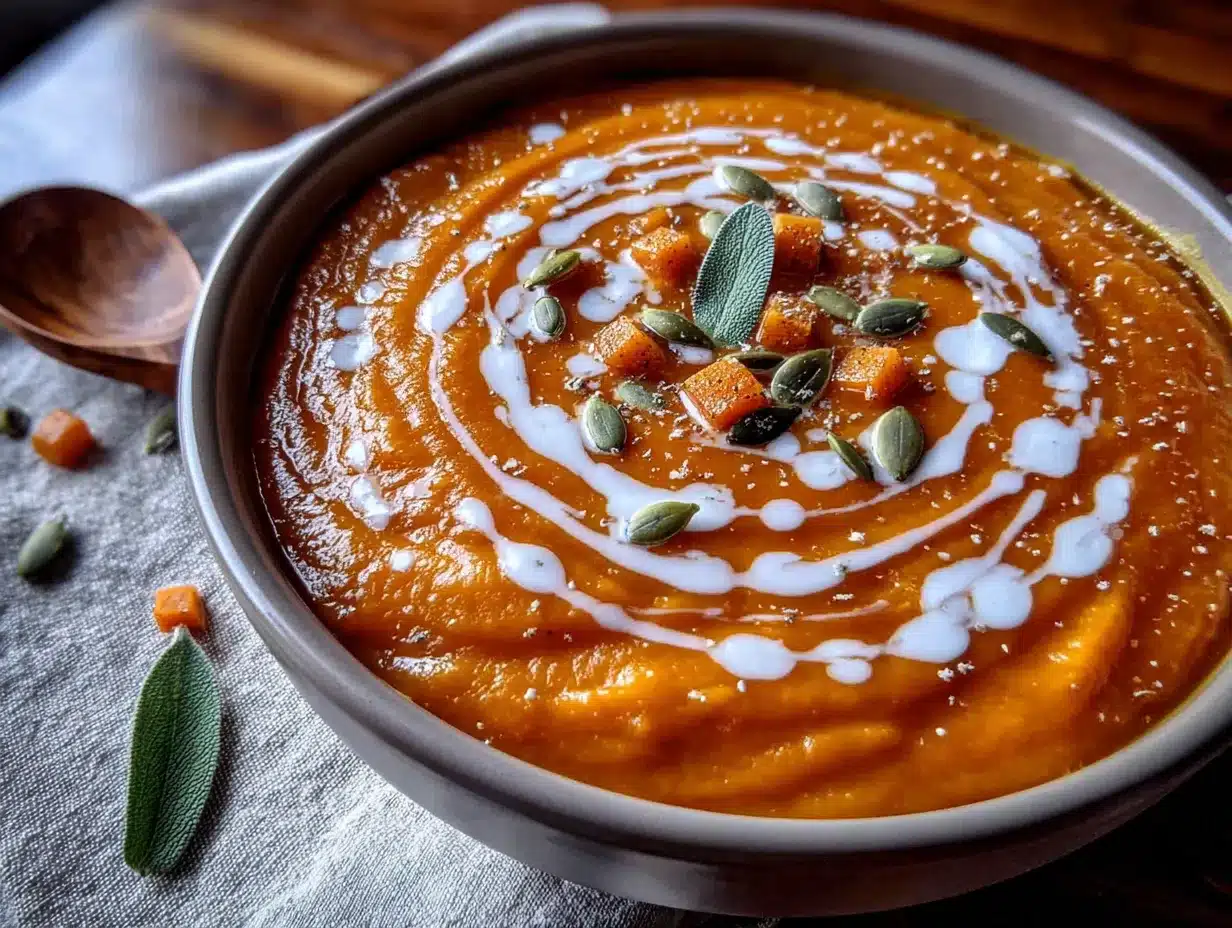
- Serve immediately — Ladle into bowls and add your chosen toppings. A swirl of extra coconut milk, a sprinkle of toasted pumpkin seeds, and a few fresh thyme leaves make it look restaurant-worthy.
Important note : The soup thickens as it cools. If you’re reheating leftovers, add a splash of broth or water to thin it back to your preferred consistency. I learned this the hard way when I tried to reheat a container that had turned into squash pudding overnight.
Cooking Tips & Techniques
After making this soup roughly twenty times over the past two falls, I’ve collected some hard-won wisdom. Here are the things I wish someone had told me.
Don’t skip the coconut milk — I tried making this with just broth once, thinking I’d save calories. The result was thin and sad. The coconut milk adds body and richness that makes the soup feel indulgent. If you’re dairy-free, this is your best friend. If you’re not, you can substitute heavy cream, but add it after blending to avoid curdling.
Toast your spices first — This is optional but transformative. Before adding the smoked paprika and cinnamon to the slow cooker, toast them in a dry pan over medium heat for about 30 seconds until fragrant. It wakes up their oils and adds a deeper flavor. I do this when I’m feeling fancy or when I want to impress dinner guests.
Peel squash in the microwave — This changed my life. Poke the whole squash several times with a fork, microwave it on high for 2 minutes, let it cool slightly, and the skin comes off with a vegetable peeler like butter. No struggling with raw squash or risking your knife skills.
Watch the salt — Different broths have wildly different sodium levels. I once used a full-sodium broth and ended up with soup that tasted like seawater. Always start with less salt, then add more after blending. You can always add salt, but you can’t take it out.
Blend in stages — If using a regular blender, don’t fill it more than halfway. Hot liquid expands and can blow the lid off. I learned this lesson when my kitchen ceiling got a nice coating of butternut squash soup. Let the soup cool for 10-15 minutes before blending, hold the lid with a folded towel, and start on the lowest speed.
Variations & Adaptations
This recipe is incredibly flexible. Here are some ways I’ve adapted it for different diets, seasons, and cravings.
Vegan and dairy-free — This recipe is already vegan if you use vegetable broth and coconut milk. The coconut milk adds all the creaminess you need without any dairy. For an extra-rich version, blend in a soaked cashew or two before serving.
Low-carb / keto adaptation — Butternut squash has natural sugars, so this isn’t strictly low-carb. But you can reduce the carbs by swapping half the squash for cauliflower florets. The cauliflower blends into the same silky texture, and the apples still provide sweetness. Omit the maple syrup entirely.
Spicy version — Add 1/2 teaspoon of cayenne pepper or a minced jalapeño (seeds removed) along with the other spices. The heat contrasts beautifully with the sweet apples and squash. I made this version for a Super Bowl party and it was gone in thirty minutes.
Herb-forward variation — Swap the smoked paprika and cinnamon for 2 teaspoons of fresh thyme leaves and 1 teaspoon of rubbed sage. This gives the soup a more savory, almost Thanksgiving-like flavor profile. Top with crispy fried sage leaves for extra crunch.
Roasted version (no slow cooker) — If you’re in a hurry or want deeper caramelized flavor, roast the squash and apples at 400°F for 25-30 minutes until browned. Then simmer everything on the stovetop for 15 minutes before blending. The roasting adds a nutty complexity that’s different from the slow cooker version but equally delicious.
Apple cider swap — Replace 1 cup of the vegetable broth with apple cider for a more pronounced apple flavor. This works especially well in late fall when fresh cider is everywhere. Just be aware it adds sweetness, so reduce or skip the maple syrup.
Serving & Storage Suggestions
This soup is versatile enough for casual weeknights and fancy dinner parties alike.
Serving temperature — Serve it hot, but not boiling. I let it rest for 5 minutes after blending so the flavors settle. A too-hot soup masks the subtle sweetness of the apples and the warmth of the ginger.
Presentation ideas — For a simple weeknight dinner, ladle into bowls and top with a drizzle of coconut milk and a few cracks of black pepper. For guests, add a swirl of coconut cream, a sprinkle of toasted pumpkin seeds, and a tiny sprig of fresh thyme. It looks like something from a fancy restaurant but takes thirty seconds.
What to serve alongside — This soup pairs beautifully with crusty bread for dipping. A grilled cheese sandwich with sharp cheddar is my personal favorite pairing. For a lighter option, serve with a simple arugula salad dressed with lemon vinaigrette. The peppery greens cut through the soup’s richness perfectly.
Storage instructions — Let the soup cool completely, then transfer to airtight containers. It keeps in the refrigerator for up to 5 days. The flavor actually improves after day one as the spices meld together. I often make a double batch on Sunday and eat it for lunches all week.
Freezing instructions — This soup freezes beautifully. Pour cooled soup into freezer-safe bags or containers, leaving an inch of headroom for expansion. It keeps for up to 3 months. Thaw overnight in the refrigerator before reheating.
Reheating tips — Reheat on the stovetop over medium-low heat, stirring occasionally. Add a splash of broth or water if it’s too thick. You can also microwave individual portions in 30-second bursts, stirring between each. Don’t boil it vigorously or the coconut milk can separate.
Nutritional Information & Benefits
This soup is as nourishing as it is delicious. Here’s what you’re getting in each serving (based on 6 servings).
Estimated nutrition per serving : Calories: 210, Total Fat: 9g, Saturated Fat: 7g, Cholesterol: 0mg, Sodium: 580mg, Total Carbohydrates: 32g, Dietary Fiber: 6g, Sugars: 14g, Protein: 3g, Vitamin A: 280% DV, Vitamin C: 45% DV, Potassium: 650mg.
Health highlights : Butternut squash is packed with vitamin A for immune health and eye function. Apples provide fiber and vitamin C. Ginger has anti-inflammatory properties, and coconut milk offers healthy medium-chain triglycerides (MCTs) that support energy metabolism. This soup is naturally gluten-free, dairy-free, and vegan.
Dietary considerations : As written, this recipe is suitable for vegan, vegetarian, gluten-free, and dairy-free diets. For nut-free diets, ensure your coconut milk is from a reputable brand that doesn’t process tree nuts on shared equipment. For low-FODMAP diets, use garlic-infused oil instead of whole garlic and skip the onion.
Personal note : I love that this soup feels indulgent but is actually packed with vegetables and fiber. It’s the kind of meal that fills you up without weighing you down. Perfect for those evenings when you want comfort food that doesn’t leave you regretting your choices.
Conclusion
This slow cooker butternut squash apple soup is proof that sometimes the best recipes come from being proven wrong. I spent years avoiding soup, convinced it wasn’t for me, and now this is the recipe I make more than any other during fall. It’s cozy without being heavy, sweet without being cloying, and simple enough for a Tuesday night but impressive enough for company.
I hope you give it a try and make it your own. Maybe you’ll add extra ginger like I sometimes do, or top it with crispy sage leaves when you’re feeling fancy. That’s the beauty of a good base recipe—it leaves room for your creativity. If you make this soup, I’d love to hear how it turned out. Drop a comment below with your favorite variation or tag me in your photos. And if you’re still not sure you’re a soup person, well, I understand. Just save this recipe for the day someone shows up at your door with a container of something unexpected.
Frequently Asked Questions
Can I use frozen butternut squash instead of fresh?
Absolutely. Frozen cubed butternut squash works perfectly here and saves you the peeling and chopping time. No need to thaw it first—just add it frozen and increase the cooking time by about 30 minutes on LOW. The texture will be just as silky after blending.
Why did my soup turn out watery?
This usually happens from too much liquid or undercooked squash. Make sure you’re using exactly 4 cups of broth and not adding extra. Also, cook until the squash is very tender—fork should slide in with zero resistance. If your soup is already watery, simmer it uncovered on the stovetop for 10-15 minutes to reduce and concentrate the flavor.
Can I make this soup in an Instant Pot?
Yes! Sauté the onion and garlic on the Saute function for 3 minutes, then add all remaining ingredients except the coconut milk. Pressure cook on HIGH for 10 minutes with a natural release. Stir in the coconut milk, then blend. It’s ready in under 30 minutes total.
How do I make this soup thicker?
For a thicker soup, reduce the broth to 3 cups, or add 1/2 cup of cooked white beans or a small potato during cooking. Both blend into the soup without changing the flavor. Alternatively, let the finished soup simmer uncovered for 10-15 minutes to evaporate excess liquid.
Can I leave the apple peels on?
You can, but the soup won’t be as silky smooth. The peels add fiber and nutrients, but they also create a slightly grainy texture after blending. If you’re using a high-powered blender like a Vitamix, the peels will break down more completely. For an immersion blender, I recommend peeling for the smoothest results.
Pin This Recipe!
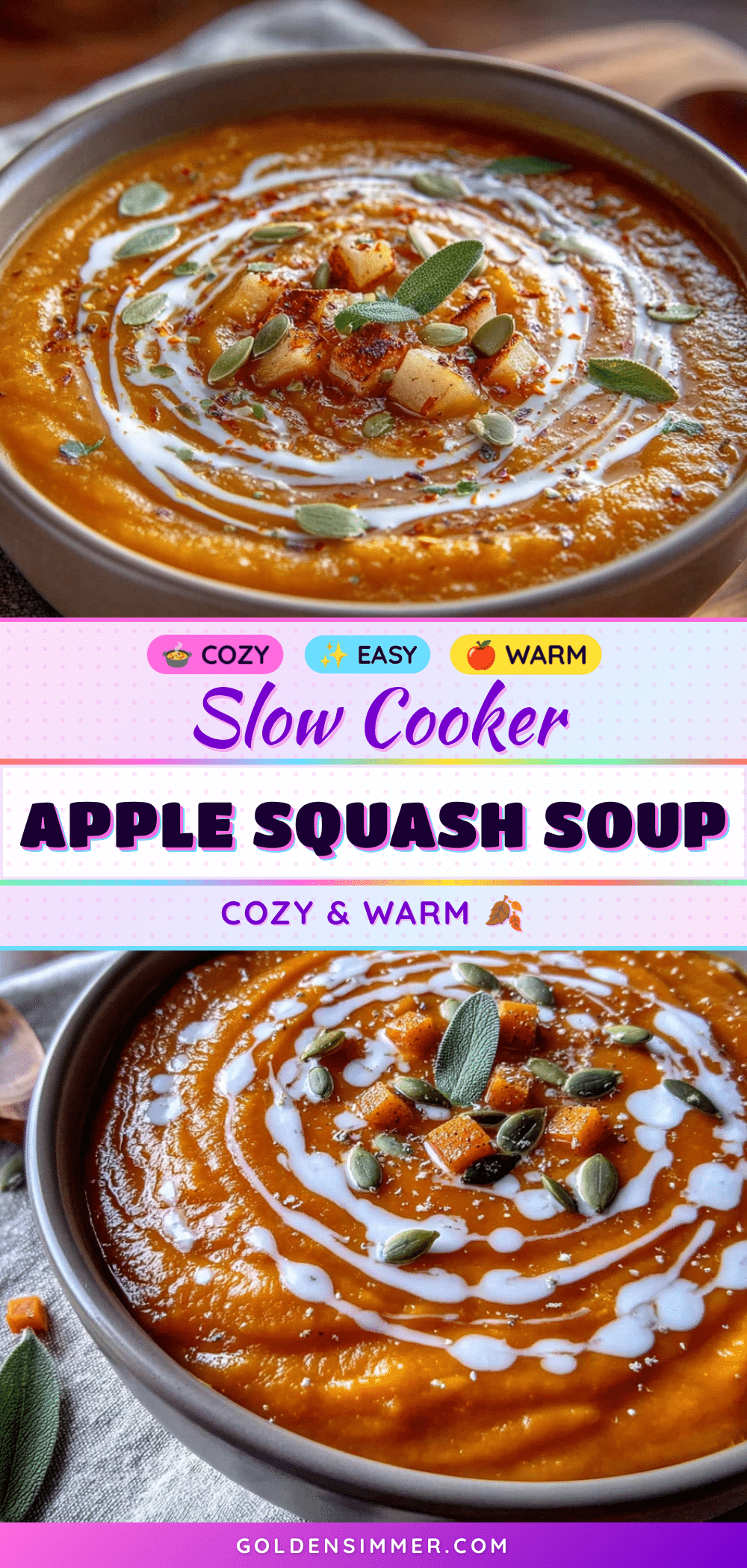
Easy Slow Cooker Butternut Squash Apple Soup Recipe

A velvety, naturally creamy soup that balances sweet apples and earthy butternut squash with warm spices. This set-it-and-forget-it slow cooker recipe is perfect for fall gatherings and meal prep.
- Prep Time: 15 minutes
- Cook Time: 6-8 hours (LOW) or 3-4 hours (HIGH)
- Total Time: 6 hours 15 minutes to 8 hours 15 minutes
- Yield: 6 servings
- Category: Soup
- Cuisine: American
Ingredients
- Butternut squash, peeled and cubed (about 4 cups)
- Granny Smith apples, peeled and chopped (2 medium)
- Honeycrisp apple, peeled and chopped (1 medium)
- Yellow onion, diced (1 large)
- Garlic cloves, minced (3-4)
- Vegetable broth (4 cups)
- Coconut milk, full-fat (1 cup)
- Fresh ginger, grated (1 tablespoon)
- Maple syrup (1-2 tablespoons, optional)
- Smoked paprika (1/2 teaspoon)
- Cinnamon (1/2 teaspoon)
- Salt (1 teaspoon, plus more to taste)
- Black pepper (1/4 teaspoon, plus more to taste)
- Optional toppings: toasted pumpkin seeds, coconut cream swirl, fresh thyme, crispy sage leaves
Instructions
- Prep the squash: Peel the butternut squash using a vegetable peeler, cut in half lengthwise, scoop out seeds, and cut into 1-inch cubes (about 4 cups).
- Prep the apples: Peel both types of apples, core them, and chop into rough 1-inch pieces.
- Combine in the slow cooker: Add cubed squash, chopped apples, diced onion, and minced garlic to a 6-quart slow cooker. Toss to distribute evenly.
- Add liquids and seasonings: Pour in vegetable broth, coconut milk, and grated ginger. Add smoked paprika, cinnamon, 1 teaspoon salt, and 1/4 teaspoon black pepper. Stir until spices are incorporated. Add another 1/2 cup broth if liquid doesn’t almost cover solids.
- Cook low and slow: Cover and cook on LOW for 6-8 hours or on HIGH for 3-4 hours, until squash is fork-tender and apples have melted into the liquid.
- Blend until smooth: Turn off slow cooker. Use an immersion blender to blend until completely smooth, about 2-3 minutes. Alternatively, let cool 10 minutes then blend in batches in a regular blender, filling no more than halfway.
- Taste and adjust: After blending, taste and add maple syrup (1 tablespoon at a time), more salt, or extra pepper as needed. Stir well after each adjustment.
- Serve immediately: Ladle into bowls and add desired toppings like a swirl of coconut milk, toasted pumpkin seeds, and fresh thyme.
Notes
The soup thickens as it cools. When reheating leftovers, add a splash of broth or water to thin to desired consistency. For a thicker soup, reduce broth to 3 cups or add 1/2 cup cooked white beans before blending. To save time, use pre-cut frozen butternut squash (add frozen and increase LOW cooking time by 30 minutes). For a roasted version, roast squash and apples at 400°F for 25-30 minutes, then simmer on stovetop for 15 minutes before blending.
Nutrition
- Serving Size: 1 serving (about 1.5
- Calories: 210
- Sugar: 14
- Sodium: 580
- Fat: 9
- Saturated Fat: 7
- Carbohydrates: 32
- Fiber: 6
- Protein: 3
Keywords: slow cooker butternut squash soup, apple soup, fall soup, vegan soup, gluten-free soup, dairy-free soup, butternut squash apple soup